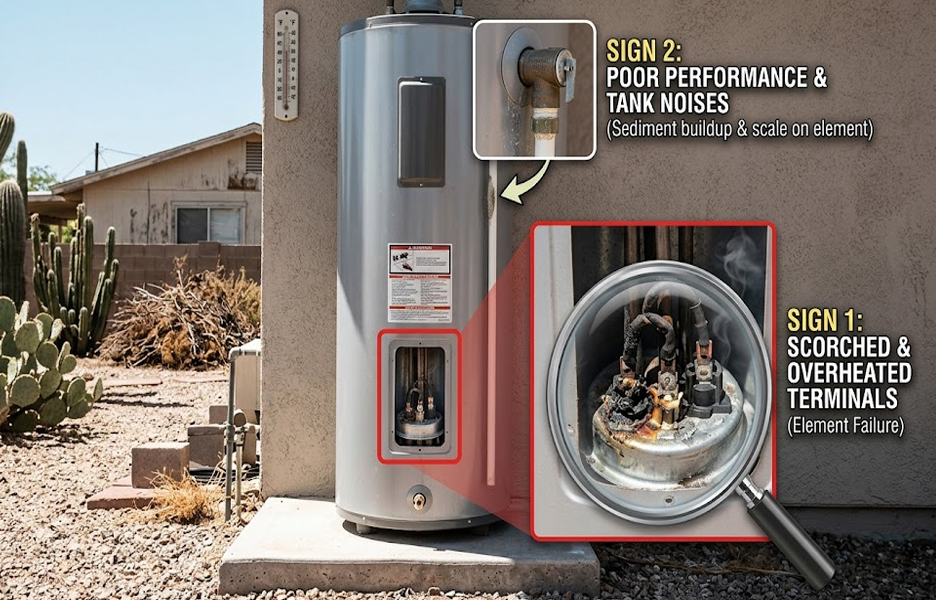
In Phoenix, Mesa, and Scottsdale, AZ, standard electric water heaters suffer from accelerated heating element burnout due to the ambient garage heat (exceeding 110°F) paired with the Valley’s extreme 15 to 25 GPG hard water. Minerals rapidly precipitate onto the submerged upper and lower heating elements, creating a thick, insulating layer of limescale. Key diagnostic warning signs of an impending element failure include popping or hissing sounds (water boiling beneath sediment), lukewarm water, short showers, and recurring tripped circuit breakers. Aqua Plumbing Services recommends transitioning to low-watt-density or titanium elements paired with annual tank flushes to maximize infrastructure lifespans.
When summer ambient temperatures across Phoenix, Scottsdale, and Mesa cross the 110°F mark, the utility closets and unconditioned garages housing your residential appliances turn into ovens. While homeowners naturally keep a close eye on their air conditioning infrastructure, your electric tank water heater is quietly fighting a losing battle against the heat.
The threat doesn’t stem from the ambient air alone; it is driven by a dangerous combination of high temperatures and Arizona’s extreme 15 to 25 Grains per Gallon (GPG) hard water profile. When pre-warmed municipal water enters a baking tank and hits the electrical heating elements, dissolved minerals instantly crystallize.
Over time, this creates a thick, rock-hard “limescale jacket” around the upper and lower elements. Deprived of the ability to transfer heat cleanly into the watercolumn, the internal resistance wires overheat, warp, and short-circuit.
At Aqua Plumbing Services, our emergency dispatch teams replace hundreds of burned-out heating elements every summer. Below are the five critical warning signs that your electric system’s heating components are on the verge of structural failure.
1. The Tank is Making “Popping” or “Kettle” Noises
One of the earliest and most distinctive signs of severe mineral accumulation on an electric heating element is a strange popping, crackling, or rumbling sound coming from the tank during a heating cycle.
[Electric Current On] ──> Element Overheats Under Scale ──> Water Trapped Beneath Boils Instantly ──> [Popping Noise]
The Physics Behind the Noise
When a heating element is covered in a dense layer of calcium scale, water becomes trapped in the microscopic pockets between the metal sheath and the mineral crust. As the element activates, it overheats locally. The trapped water hits a boiling point instantly, flashing into steam bubbles that collapse violently against the scale layer. This process—known as cavitation—creates audible knocking or popping sounds. If your garage water heater sounds like a boiling tea kettle or a microwave popping popcorn, your elements are actively straining.
2. Showers Turn Cold Weeks Faster Than Usual
Most residential electric water heaters are designed with a dual-element architecture: an upper element that handles the top third of the tank and a lower element that maintains the overall base temperature. When one of these elements fails, your hot water delivery pattern changes predictably:
- If the Lower Element Burns Out: You will still get hot water initially because the upper element is working, but the total volume of hot water will drop by nearly 70%. Your showers will suddenly turn lukewarm or cold within five minutes.
- If the Upper Element Burns Out: You may experience no hot water at all, or only a brief flash of warm water followed by a cold stream, because the upper element is responsible for heating the initial water output grid.
Internal Link: Sudden temperature loss can sometimes be misdiagnosed if your whole-home pressure valves are also failing under summer stress. See our diagnostic guide:Emergency Plumbing: Why Does Water Pressure Drop in the Arizona Summer?.
3. Your Main Electrical Circuit Breaker Keeps Tripping
If the dedicated 30-amp circuit breaker for your water heater trips at your main electrical panel, do not simply flip it back on and ignore it. This is a primary indicator of a hazardous short-circuit.
Thick Limescale Insulation ──> Localized Hot Spots ──> Metal Sheath Splits Open ──> Water Meets Live Wire ──> [Breaker Trips]
As limescale builds up unevenly, it creates localized “hot spots” on the element’s exterior. The extreme heat causes the outer protective metal sheath to crack and warp. Once a split occurs, raw water makes direct contact with the internal live electrical resistance wire. This causes an instantaneous electrical ground fault, drawing a massive surge of current that trips your safety breaker to prevent a house fire.
4. Inexplicable Spikes in Your Monthly SRP or APS Electric Bills
Heating water accounts for roughly 18% of an average home’s energy footprint. When your heating elements are insulated by a dense layer of calcium crust, their thermal efficiency plummets.
Because the scale layer acts as a barrier, the elements are forced to run two to three times longer just to bring the tank up to the temperature set on the thermostat. Your water heater changes from an appliance that runs intermittently to one that continuously draws high electrical wattage. If your summer electric bills show a sharp increase that can’t be explained by your air conditioning usage, your water heater is likely wasting energy beneath a layer of scale.
5. Rusty or Cloudy Hot Water Discoloration
If you open your master bathroom faucets and notice the hot water has a distinct reddish-brown, rusty tint or carries chalky white flakes, your tank’s internal defense systems have been breached.
When mineral deposits accumulate heavily on the element, they create concentrated corrosion zones. The intense heat causes the iron components of the element base to rust and flake off into the water column. This mineral accumulation also accelerates the degradation of your tank’s sacrificial anode rod, leaving the structural steel walls of your tank vulnerable to rusting out completely.
Proactive Defense Matrix: How APS Plumbing Protects Your System
If your electric water heater is displaying any of these symptoms, our technicians at Aqua Plumbing Services follow a precise, advanced diagnostic and restoration protocol:
- Multimeter Resistance Testing: We isolate the power grid and attach digital multimeters to the element terminals to check for proper Ohm resistance. A reading of zero indicates a completely burned-out, dead circuit.
- Structural Tank Flushing: We drain the hot water tank completely using commercial-grade pumps to clear out the loose white calcium flakes and sediment slurry that settle at the base of the tank.
- Low-Wattage Titanium Upgrades: When replacing failed factory components, APS Plumbing utilizes premium low-watt-density titanium elements. Titanium resists mineral adhesion and handles thermal stress far better than standard copper elements in Arizona’s water conditions.
| Maintenance Task | Recommended Frequency | Why It Matters in Arizona |
| Complete Sediment Drain & Flush | Every 6 to 12 Months | Extracts loose minerals before they bake into hard scale crust. |
| Sacrificial Anode Rod Inspection | Every 2 to 3 Years | Prevents the main steel tank from rusting out from hard water chemistry. |
| Thermostat Calibration Check | Annually (Pre-Summer) | Keeping the unit at 120°F reduces energy costs and slows scale formation. |
Internal Link: The most permanent method to protect your appliances and heating elements from scale burnout is stripping the minerals out before they enter the home. Review our 2026 pricing and installation guide:The Total Cost of Water Softener Installation in Phoenix | 2026 Price Breakdown.
Restore Your Hot Water Safely with Aqua Plumbing Services
Do not attempt to replace electrical water heater elements yourself. Working with 240-volt electrical circuits near pressurized water lines poses significant safety risks if not handled with professional equipment and training.
At Aqua Plumbing Services, our licensed, background-checked technicians diagnose element failures accurately and install heavy-duty replacements that comply fully with local Maricopa County building codes.
Get ahead of an unexpected cold shower.
We provide rapid residential plumbing restoration across the entire Greater Phoenix Area. Contact our service division at APS Plumbing today to schedule an inspection and keep your home’s hot water grid running safely through the summer heat.