Quick answer: In Phoenix, Scottsdale, Mesa, Chandler and the rest of Maricopa County, most plumbing work beyond simple repairs needs a permit from the city or county: water heater replacement, repiping, sewer line work, gas piping, water softener and irrigation connections, and moving fixtures in a remodel. In Arizona, any job that requires a permit, or costs $1,000 or more in labor and materials, must be done by an ROC-licensed contractor; the “handyman exemption” does not apply to permitted work. Homeowners can pull some permits for their own home under the owner-builder exemption.
Each city in Maricopa County runs its own permit office, so forms and fees differ, but the rules for what needs a permit and who may do the work are similar across the Valley. Here is a practical overview for homeowners.
Which plumbing jobs need a permit?
| Project | Permit usually required? |
|---|---|
| Water heater replacement (tank or tankless) | Yes, in Phoenix, Scottsdale and most Valley cities |
| Whole-home repipe or replacing water lines | Yes |
| Sewer line repair or replacement | Yes |
| Gas line installation, extension or relocation | Yes |
| Water softener plumbing, recirculation pump, irrigation tie-in | Often yes (minimum permit) |
| Remodel that moves fixtures, drains or vents | Yes |
| Faucet cartridge, showerhead, toilet flapper or fill valve | Generally no |
Rules vary by city, so confirm with your local building department. For Scottsdale specifics, see our Scottsdale plumbing permit guide.
Who can legally pull a plumbing permit in Arizona?
Licensed contractors
The Arizona Registrar of Contractors (ROC) states that, generally, if labor and materials exceed $1,000 or a permit is required regardless of price, a license is required. Plumbing contractors hold ROC plumbing classifications for residential or commercial work. You can verify any contractor’s license on the ROC website.
The handyman exemption
Arizona’s “handyman exemption” (A.R.S. § 32-1121(A)(14)) lets unlicensed workers do casual or minor jobs under $1,000, but it does not apply to any work that requires a building permit. A water heater swap or gas line, for example, needs a licensed contractor even if the price is low.
Owner-builders
Homeowners may pull permits and do work on their own property under the owner-builder exemption. The structure must not be intended for sale or rent; selling or renting within a year of completion can be treated as evidence that it was. The owner is responsible for meeting code and passing inspections.
What inspections to expect
- Underground / under-slab: drain slope, bedding and a pressure or water test before concrete or backfill.
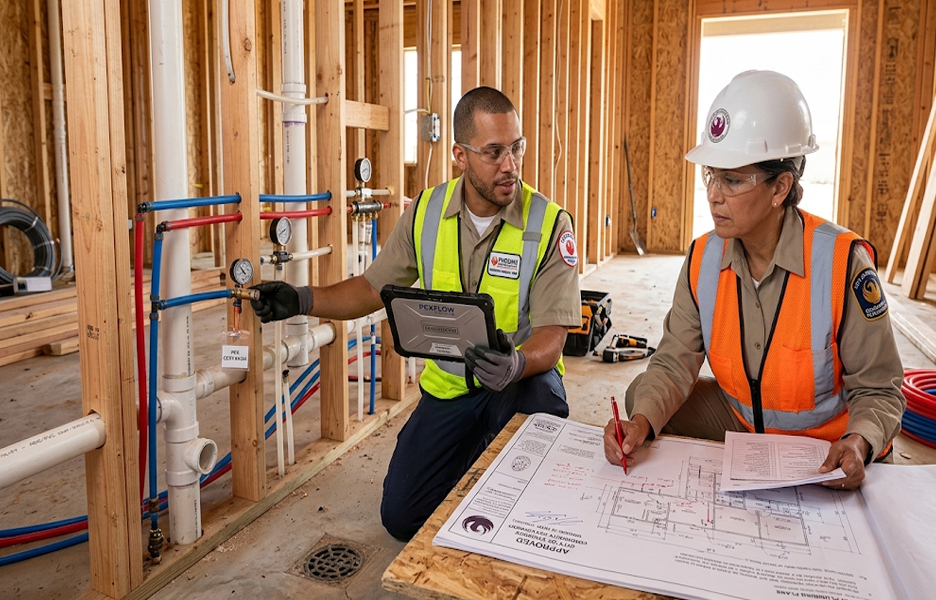
- Rough-in: before drywall, inspectors check supports, protection plates, venting and a pressure test.
- Final: fixtures, backflow protection, water heater relief valve and drain, venting and gas connections.
Minimum permits such as a water heater replacement often need only a final inspection.
Two code rules that matter in the Valley
- 80 PSI maximum: the International Plumbing Code requires a pressure reducing valve when static water pressure exceeds 80 PSI. Many Valley homes need one; see PRV failure signs.
- Backflow protection on irrigation: landscape systems connected to drinking water need an approved backflow preventer, and many cities require periodic testing.
Why skipping the permit is risky
- Home sales: buyers and inspectors often check permit history; unpermitted work can delay closing or lead to concessions.
- Insurance: claims involving unpermitted work may be questioned. See our pipe leak insurance claim guide.
- Safety: incorrect gas or venting work can cause leaks or carbon monoxide problems.
- Retroactive permits: work can often be permitted afterward, but inspectors may require walls or floors to be opened.
APS Plumbing pulls permits and schedules inspections for repiping, water heater installation, gas line installation and renovation plumbing across Maricopa County.
Frequently Asked Questions
Do I need a permit to replace a water heater in Phoenix?
Yes. Phoenix and most Maricopa County cities require a permit and inspection for water heater replacement.
Can a handyman replace a water heater in Arizona?
Not legally if the job requires a permit. Arizona’s handyman exemption does not apply to work that requires a building permit, so a licensed contractor is needed.
Can a homeowner pull a plumbing permit in Arizona?
Yes, under the owner-builder exemption for their own property, as long as it is not built or improved for sale or rent. The owner is responsible for passing inspections.
Can unpermitted plumbing work be permitted later?
Usually yes, through a retroactive permit, but the inspector may require finished surfaces to be opened to verify the work.
Need a plumber in Scottsdale or Phoenix?
APS Plumbing (Aqua Plumbing Services LLC) answers 24/7 across Scottsdale, Phoenix, Paradise Valley, Tempe, Mesa, Chandler, Gilbert and Glendale. 10% off for military personnel and 12 months no-interest financing available.