Homeowners across Phoenix, Scottsdale, Mesa, and Paradise Valley love tankless water heaters for their compact footprint and unlimited hot water during hot summer months. Between May and September, shallow municipal water lines absorb intense desert heat, delivering incoming tap water at 80°F to 85°F. Under those conditions, a tankless unit barely works to reach a standard 120°F shower. However, when crisp autumn gives way to winter cold snaps and nighttime desert temperatures drop into the 20s and 30s, homeowners frequently notice a puzzling drop in performance: flow rates suddenly restrict, water takes longer to heat up, or multiple showers cannot run simultaneously.
This seasonal drop in performance is not necessarily a mechanical breakdown; it is the physical reality of tankless cold groundwater in Phoenix. In winter, municipal groundwater temperatures drop by nearly 30 degrees, placing peak thermal and combustion demands on on-demand systems. Below is an engineering breakdown of winter Delta-T shifts, why flow restrictors engage, and how to maintain high efficiency throughout the coldest desert nights.
1. The Winter Delta-T Reality: Summer vs. Winter Heating Loads
Tankless water heaters do not store pre-heated water; they heat water instantaneously as it flows across a high-output burner heat exchanger. Their delivery capacity depends on temperature rise (Delta-T, or ΔT):
- The Summer Profile (35°F Delta-T): During desert summers, incoming tap water enters your home at approximately 85°F. To achieve a comfortable 120°F delivery, the burner only needs to raise the water temperature by 35°F. At this low temperature rise, a standard 199,000 BTU unit easily outputs 8 to 9 Gallons Per Minute (GPM)—plenty of capacity to run three showers and a washing machine simultaneously.
- The Winter Profile (65°F Delta-T): In December and January, groundwater sourced from deep aquifers, the Verde River, or the Central Arizona Project cools to 55°F or lower. To heat 55°F water up to 120°F, the unit must deliver a 65°F temperature rise. Because the unit’s maximum gas burner input is capped (typically at 180,000 or 199,900 BTUs), maximum continuous output drops from 9 GPM down to approximately 5.0 to 5.7 GPM.
- Automatic Flow Servomotors: Premium units (such as Navien, Rinnai, and Noritz) feature internal water flow control servomotors. If hot water demand exceeds what the burner can raise to 120°F, the unit automatically restricts total gallon volume to prevent delivering lukewarm water. You get fully heated water, but at a noticeably lower volume.
2. Why Desert Hard Water Compounds Winter Efficiency Losses
Arizona groundwater contains heavy concentrations of dissolved minerals (15–25 grains per gallon). During the winter, when burners fire at maximum BTU capacity, hard water scale causes pronounced efficiency problems:
- The Thermal Insulator Effect: Calcium carbonate precipitates rapidly along the narrow, convoluted passages of the heat exchanger coils. Scale acts as a dense thermal barrier between the gas flame and the water flow. With even 1/16-inch of scale, thermal transfer efficiency drops by over 15%, forcing the unit to consume more natural gas or propane while struggling to maintain target temperatures.
- Combustion Short-Cycling & Error Codes: When a scaled heat exchanger cannot transfer burner heat quickly enough into incoming winter water, internal high-limit sensors detect an overheat condition. The unit cuts the flame to protect the heat exchanger, resulting in a sudden blast of cold water in the shower accompanied by ignition error codes on the digital wall controller.
3. Exterior Tankless Units & Desert Freeze Vulnerabilities
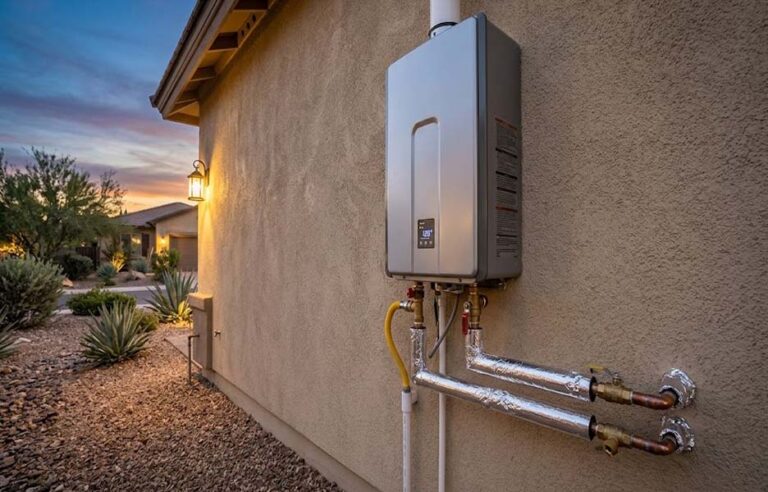
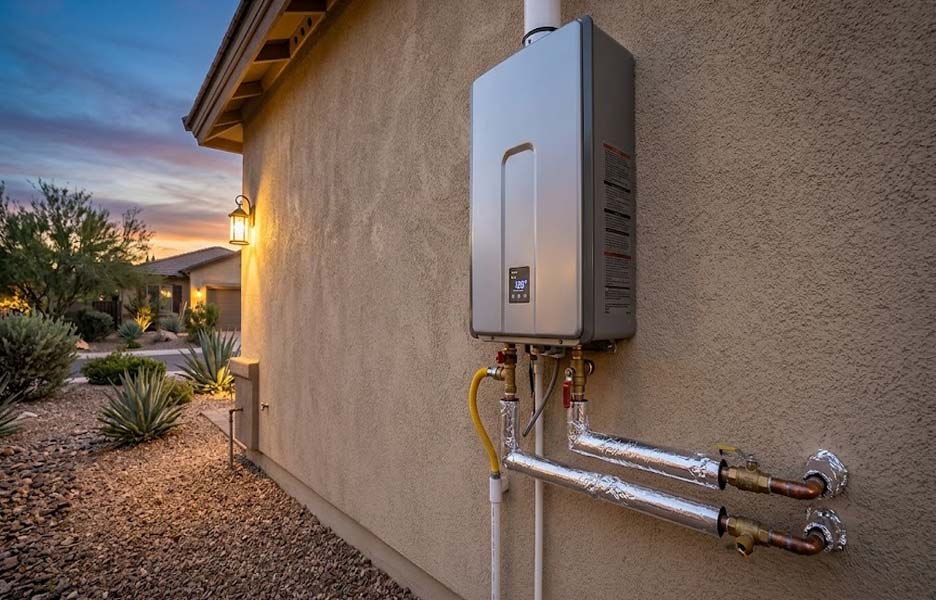
In older tract subdivisions and luxury modern builds across Maricopa County, tankless water heaters are frequently mounted on exterior stucco walls or inside unconditioned garages to save interior living space. Exterior units face distinct winter hazards:
- Electrical Dependence for Freeze Protection: Modern condensing tankless units feature internal ceramic heating elements designed to protect the internal heat exchanger down to -5°F. However, these safety blocks only function if the unit remains plugged into an active electrical outlet. A winter power outage during an overnight freeze disables internal protection, placing the brass and copper components at risk of freezing.
- Unprotected Exterior Plumbing Risers: While internal components are protected by electric elements, the exterior copper water lines, brass isolation service valves, and pressure relief piping running below the unit have zero internal heat. An uninsulated valve assembly can crack during a 28°F night, leading to an exterior flood.
- Condensate Line Freezing: High-efficiency condensing units produce acidic condensate water that discharges through a plastic PVC or vinyl tube. If this drain line terminates in an uninsulated outdoor location, standing condensate freezes into a solid ice plug, causing backpressure that shuts down the entire unit on error.
4. Essential Winter Tankless Maintenance Checklist
To ensure dependable hot water throughout the coldest desert months, perform these seasonal maintenance checks every autumn:
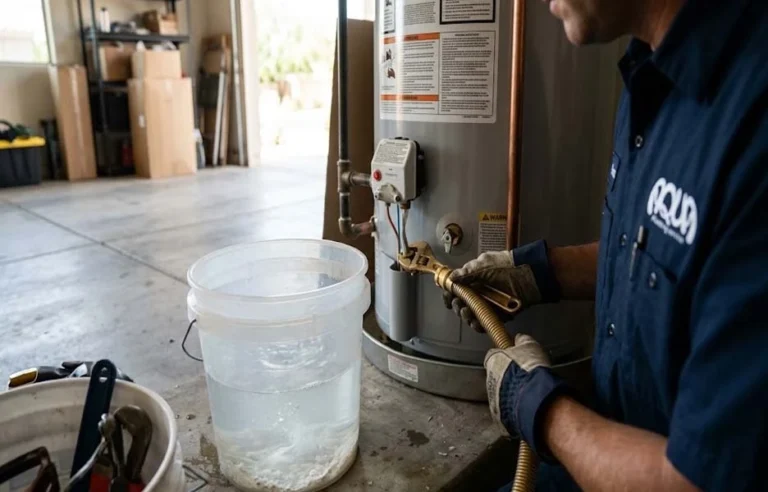
- Annual Vinegar or Citric Acid Descaling: Connect a submersible utility pump and washing machine hoses to the unit’s dedicated isolation service valves. Circulate food-grade virgin white vinegar or specialized descaling solution through the heat exchanger for 45 to 60 minutes to dissolve baked-on calcium scale.
- Clean the Cold Water Inlet Filter: Shut off water, depressurize, and remove the small plastic mesh inlet screen located at the cold water connection. Rinse away trapped sand, municipal sediment, and caliche flecks that restrict incoming winter water velocity.
- Insulate Exterior Valve Kits & Risers: Wrap all exposed copper lines, brass ball valves, and condensate drains with thick, closed-cell polyethylene foam insulation and high-grade UV-resistant pipe wrap.
For professional descaling flushes, gas line verification, or winter diagnostic checks, scheduling comprehensive water heater installation and repair services in Arizona keeps your on-demand system running smoothly through every winter cold snap.
Frequently Asked Questions: Winter Tankless Performance in Phoenix
Q: Why does my tankless water heater flow feel weaker during Arizona winters?
A: Tankless units prioritize set output temperature over volume. When incoming groundwater drops from 80°F in summer to 55°F in winter, the unit’s internal water control valve automatically restricts Gallons Per Minute (GPM) to ensure the gas burner can achieve the full 120°F target.
Q: Do outdoor tankless water heaters freeze in Phoenix?
A: While modern gas tankless units feature internal ceramic electric freeze prevention heaters for their heat exchangers, exterior copper pipes, isolation valve kits, and condensate drain lines outside the cabinet remain vulnerable to overnight freezing unless insulated.
Q: How does mineral scale affect tankless winter performance?
A: Calcium scale acts as a thermal insulator on heat exchanger copper or stainless coils. In winter, when the unit must fire at peak BTU capacity to overcome cold groundwater, scale buildup causes burner short-cycling, error codes (such as Navien E012 or Rinnai Code 11), and thermal dropouts.
5. Precision On-Demand Water Heating with APS Plumbing AZ
Ensure consistent, high-pressure hot water on the coldest desert mornings. APS Plumbing (Aqua Plumbing Services LLC) provides factory-certified tankless descaling, winterization insulation upgrades, gas burner recalibrations, and emergency diagnostic support across Phoenix, Scottsdale, Mesa, Chandler, Gilbert, and Tempe.