Discovering standing water pooling around your garage floor or utility closet early in the morning is every homeowner’s nightmare. Because traditional tank water heaters operate continuously under 50 to 75 PSI of pressure, an internal glass tank failure or bottom seam blowout releases dozens of gallons of scalding water within minutes. When a catastrophic failure strikes, searching for emergency water heater replacement near me requires an immediate, disciplined response to protect your drywall, foundation, and household safety before a licensed crew arrives.
In Maricopa County, water heaters face accelerated wear due to high groundwater mineral content (15–25 GPG) and extreme ambient summer temperatures. Below is the exact step-by-step containment protocol used by licensed technicians to stabilize an active water heater leak, along with the standards that govern same-day emergency replacements across Greater Phoenix and Scottsdale.
1. Immediate 60-Second Containment: Stopping Flood Damage
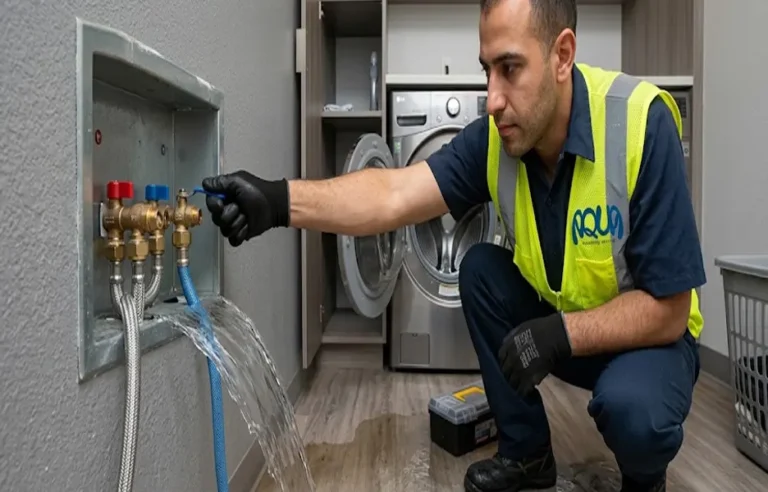
If your water heater is actively discharging water onto the floor, perform these two critical shutoff actions before calling dispatch:
- Step 1: Shut Off the Cold Water Supply Valve: Locate the cold water pipe entering the top right of the tank. Turn the valve handle clockwise (if it is a round gate valve) or 90 degrees perpendicular to the pipe (if it is a quarter-turn brass ball valve). This immediately stops fresh municipal water from pressurizing the ruptured tank.
- Step 2: Isolate the Energy Source: For a natural gas water heater, turn the front thermostat control dial to “Off” and shut the inline gas stop cock. For an electric unit, go straight to your main electrical panel and switch off the dedicated 240-volt double-pole breaker labeled “Water Heater” to avoid electrical hazards or burning out elements dry.
- Step 3: Relieve Head Pressure: Open hot water faucets inside a nearby bathtub or laundry sink to relieve pressure and allow remaining water to drain through plumbing fixtures rather than onto the floor.
2. Repair vs. Replacement: When Is a Tank Beyond Saving?
Not every water heater puddle indicates an unrecoverable failure. A licensed diagnostic evaluation quickly distinguishes between simple component repairs and structural tank ruptures:
- Repairable Issues: Leaks originating from a loose brass drain valve, failed rubber supply line gaskets, an unseated Temperature & Pressure (T&P) relief valve, or an upper heating element gasket can typically be repaired without replacing the entire vessel.
- Non-Repairable Failures: If water seeps from the bottom seams, beneath the outer decorative metal casing, or through rust-compromised burner sight glasses, the inner glass-lined steel vessel has fractured. Because hot water tanks cannot be welded or patched once cracked, an immediate full replacement is required.
3. The Same-Day Emergency Replacement Protocol in Phoenix
Professional same-day water heater installation in Phoenix follows a standardized technical workflow to restore household hot water while meeting regional safety mandates:
- Rapid Tank Extraction: Commercial submersible pumps and heavy-duty drain hoses evacuate remaining sediment-heavy water in minutes, minimizing downtime.
- Precision Sizing & First-Hour Rating: Rather than simply duplicating an outdated tank size, technicians evaluate family hot water demands, sizing for a First-Hour Rating (FHR) that accommodates simultaneous showers and laundry loads.
- Mandatory Code Compliance Upgrades: Maricopa County and City of Phoenix building codes require specific components during replacement, including a properly pressurized thermal expansion tank, a lead-free vacuum relief valve, full-bore quarter-turn shutoff valves, and code-compliant seismic restraint strapping.
- Combustion Vent & Draft Verification: On atmospheric gas units, technicians inspect B-vent piping to verify safe draft velocity, ensuring toxic carbon monoxide exhausts safely through the roof.
When facing an unrecoverable tank failure, turning to certified specialists for professional water heater replacement services across Arizona ensures prompt equipment delivery and full regulatory compliance.
Frequently Asked Questions: Emergency Water Heater Replacement
Q: How quickly can a water heater be replaced in Phoenix?
A: For active tank ruptures and major leaks, professional same-day replacement protocols allow a licensed technician to assess the setup, deliver an appropriately sized gas or electric unit, and complete the installation within 3 to 5 hours.
Q: What is the first thing I should do if my water heater bursts?
A: Shut off the cold water supply valve on the top inlet pipe immediately, and turn off the fuel source—either by switching the gas control knob to ‘Off’ or turning off the dedicated 240V double-pole circuit breaker for electric tanks.
Q: Do water heater replacements in Phoenix require a permit and inspection?
A: Yes. The City of Phoenix and Maricopa County municipal building departments mandate permits for water heater replacements to verify thermal expansion tank operation, seismic strapping, venting clearance, and temperature-pressure relief discharge safety.
4. 24/7 Rapid Emergency Replacement with APS Plumbing AZ
When your water heater bursts, waiting days for hot water is never an option. At APS Plumbing (Aqua Plumbing Services LLC), our ROC-licensed technicians maintain fully stocked service trucks and offer rapid emergency water heater replacement, professional diagnostics, and complete code-compliant installations across Phoenix, Scottsdale, Mesa, Chandler, Gilbert, and Tempe.