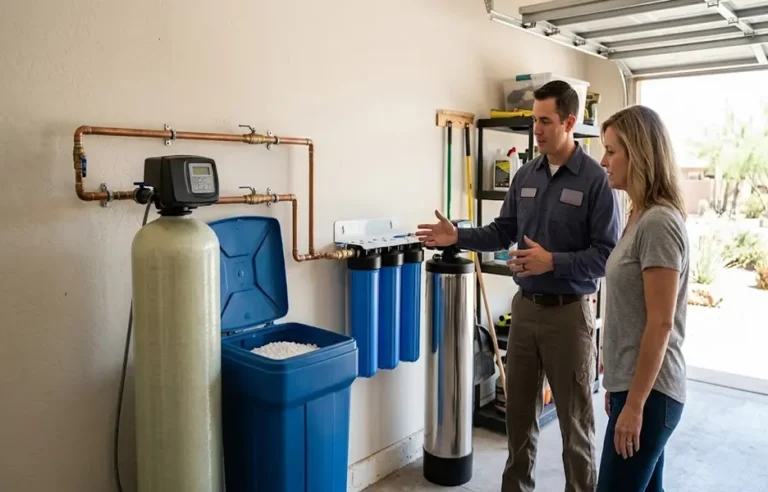
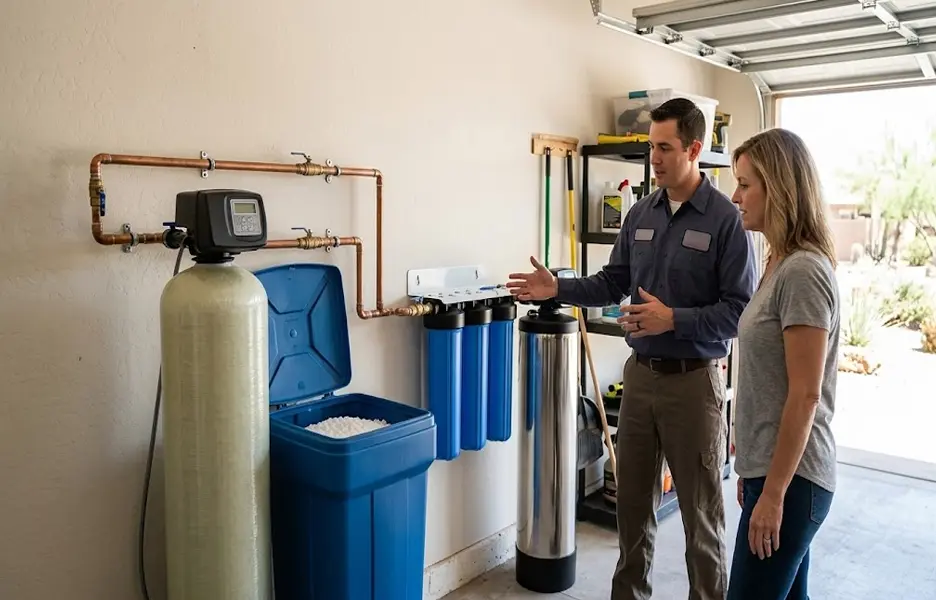
Quick answer: For Phoenix-area hard water, a metered salt-based (ion exchange) softener is the most effective type for most homes. Dual-tank (twin alternating) softeners suit very large households or homes that need soft water 24/7 without a regeneration pause. Salt-free conditioners reduce scale but do not remove hardness. Combination units add a carbon filter for chlorine taste. Choose the type first, then size it to your household.
This guide compares the types of water softeners. Once you know which type fits, use our sizing guide to choose the capacity.
Softener types at a glance
| Type | How it works | Pros | Cons |
|---|---|---|---|
| Single-tank salt-based (metered) | Ion exchange removes calcium and magnesium; regenerates based on water use | Truly soft water; efficient | Needs salt; brief regeneration period |
| Dual-tank (twin alternating) | Two resin tanks take turns | Soft water 24/7; handles heavy use | Larger, higher cost |
| Salt-free conditioner (TAC) | Changes minerals so they scale less; does not remove them | No salt, no drain, low maintenance | Not true softening; spots remain |
| Softener + carbon combo | Softening plus carbon filtration in one system | Soft water and better taste | Carbon media needs periodic replacement |
| Potassium-based softener | Same ion exchange using potassium chloride | No added sodium | Potassium costs more than salt |
Which type fits your home?
- Typical family home: single-tank metered salt-based softener.
- Large or multi-generational household: dual-tank system.
- Mainly worried about water heater scale, small household: a salt-free conditioner can be enough.
- Want better taste too: softener with carbon, plus reverse osmosis at the kitchen sink.
- Watching sodium: use potassium chloride, or drink RO water.
Features worth paying for in Arizona
- Metered (demand-initiated) regeneration
- 1-inch valve for homes with several bathrooms
- Bypass valve for easy service
- Sediment pre-filter to protect the resin
See also how hard water damages appliances, typical installation costs, and our water softener installation service.
Frequently Asked Questions
What type of water softener is best for Arizona?
For most homes, a metered salt-based softener. Large households may prefer a dual-tank system.
Is a salt-free water softener worth it?
It reduces scale on heating surfaces but does not remove hardness, so you still get spots and use more soap.
What is a dual-tank water softener?
A system with two resin tanks that alternate, so one is always in service and you have soft water around the clock.
Can I use potassium instead of salt?
Yes. Potassium chloride works in most salt-based softeners and avoids adding sodium, though it costs more.
Need a plumber in Scottsdale or Phoenix?
APS Plumbing (Aqua Plumbing Services LLC) answers 24/7 across Scottsdale, Phoenix, Paradise Valley, Tempe, Mesa, Chandler, Gilbert and Glendale. 10% off for military personnel and 12 months no-interest financing available.