Commercial Backflow Preventer Testing Requirements in Mesa and Chandler
Operating a commercial facility, industrial complex, retail center, or multi-family rental asset across Mesa, Chandler, Gilbert, and the East Valley entails strict environmental and public health compliance mandates. At the municipal, county, and state levels, commercial water distribution is governed by rigorous Cross-Connection Control Programs engineered to protect public potable drinking supplies from hazardous chemical, industrial, and biological contamination.
In arid desert regions where commercial properties utilize heavy landscape irrigation, cooling towers, fire suppression grids, and commercial boilers under fluctuating utility pressures, the risk of chemical backflow is exceptionally high.
To eliminate this public safety hazard, both the City of Mesa Water Resources Department and the City of Chandler Environmental Management Division mandate that every commercial backflow prevention assembly be inspected and certified annually by a licensed tester. Failing to submit verified test documentation can trigger substantial civil fines and emergency municipal water shut-offs.
Below is the definitive legal, technical, and procedural compliance guide for commercial property managers and business owners operating in Mesa and Chandler.
1. The Physics of Backflow: Backpressure vs. Backsiphonage
A cross-connection is any actual or potential physical link between a potable drinking water system and an unapproved water source, chemical fluid, or sewage network. Without an operational mechanical assembly, contaminated water can reverse direction into the public drinking main through two distinct hydraulic mechanisms:
1. Backsiphonage (Negative Line Pressure)
Backsiphonage occurs when municipal main pressure drops below atmospheric pressure (14.7 PSI), creating a vacuum siphon inside the line. This sudden negative pressure is commonly triggered by:
High-volume firefighting activities drawing thousands of gallons from nearby hydrants.
A catastrophic municipal water main rupture along a regional boulevard.
Severe subterranean pipe failures on adjacent properties. When a vacuum forms, untreated water from commercial chillers, boiler loops, or fertilizer injectors is siphoned backward into city pipes.
2. Backpressure (Over-Pressurization)
Backpressure occurs when the pressure generated within the private commercial facility exceeds the incoming pressure delivered by the municipal utility. This condition develops when:
High-pressure commercial booster pumps operate downstream.
Thermal expansion from boilers, autoclaves, or large water heating arrays over-pressurizes closed mechanical loops.
Closed hydronic cooling towers pump chemically treated water at pressures exceeding municipal grid levels.
To understand how high municipal pressure surges impact commercial and residential piping infrastructure, review our technical diagnostic on pressure surges:
https://apsplumbingaz.com/why-arizona-homes-struggle-with-water-pressure-issues/
2. Commercial Backflow Assembly Classifications
Municipal building safety codes categorize backflow prevention devices based on the property’s degree of hazard (High Hazard vs. Low Hazard):
| Assembly Classification | Hazard Level | Approved Commercial Applications | Mechanical Operation |
| Reduced Pressure Zone (RPZ / RPBA) | High Hazard (Health Threat) | Chemical labs, hospitals, car washes, commercial cooling towers, fertilizer injectors. | Two independent spring check valves separated by a hydraulically operated differential relief valve that vents to daylight. |
| Double Check Valve Assembly (DC / DCVA) | Low Hazard (Aesthetic Threat) | Dedicated fire sprinkler grids, dry pipe lines, commercial potable loops without chemical feeds. | Two independently acting, internally loaded spring check valves enclosed in a single brass or iron body. |
| Pressure Vacuum Breaker (PVB) | Continuous High/Low Hazard | Commercial landscape irrigation, turf drip zones, agricultural landscape perimeters. | An independently operating spring-loaded check valve and an independently operating spring-loaded air inlet valve. |
To learn how exterior irrigation fractures compromise assemblies and waste municipal water, explore our diagnostic on how to identify an underground yard leak and irrigation breaks:
https://apsplumbingaz.com/how-to-identify-yard-leak-underground-irrigation/
3. Municipal Testing Protocols: City of Mesa vs. City of Chandler
Both municipalities enforce the Arizona Department of Environmental Quality (ADEQ) Title 18 administrative rules and follow the University of Southern California Foundation for Cross-Connection Control and Hydraulic Research (USC-FCCCHR) standards:
City of Mesa Mandates (Title 8, Chapter 3 of Mesa City Code)
Annual Recertification: Every commercial backflow preventer must be tested at least once every 365 days.
30-Day Testing Window: The City of Mesa sends formal compliance reminder notices approximately 30 to 45 days before the certification expiration date. Testing must be completed and logged prior to the listed deadline.
Electronic Portal Submittal: Test results can no longer be hand-delivered or mailed. Results must be submitted directly through the City of Mesa Backflow Online Tracking System by a certified tester with an active testing profile.
Post-Repair Retesting: If an assembly fails testing, it must be rebuilt or replaced and retested within 15 business days.
City of Chandler Mandates (Chandler Municipal Code Chapter 51)
Annual Mandatory Certification: Enforced rigorously for all commercial, industrial, and multi-family irrigation meters.
Tester Licensing Requirements: Testers must hold an active certification card from recognized accrediting bodies: the American Backflow Prevention Association (ABPA) or the Arizona Cross-Connection Control Association (ABPA/AZ-CCCA).
Direct Compliance Reporting: Chandler requires all certified test forms to be submitted electronically to the Environmental Management Division with certified gauge calibration certificates attached.
Learn more about contractor licensing compliance, ROC rules, and municipal inspection milestones in our guide to plumbing permits in Maricopa County:
https://apsplumbingaz.com/plumbing-permits-maricopa-county-legal-safety-guide/
4. What Happens During a Certified Backflow Field Test?
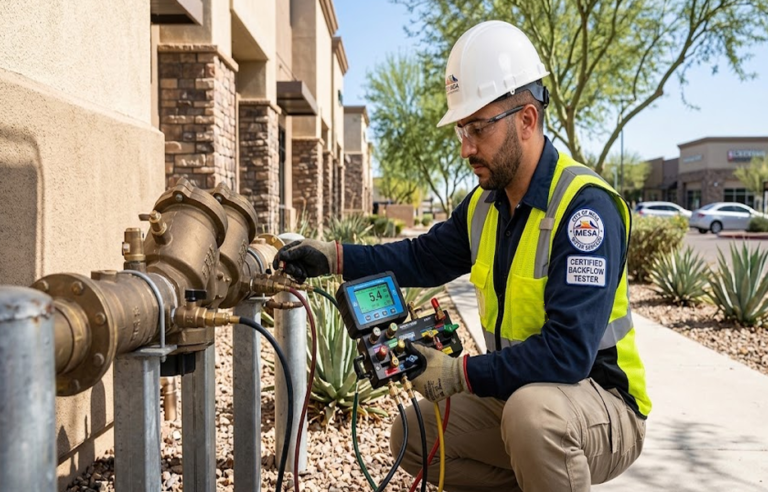
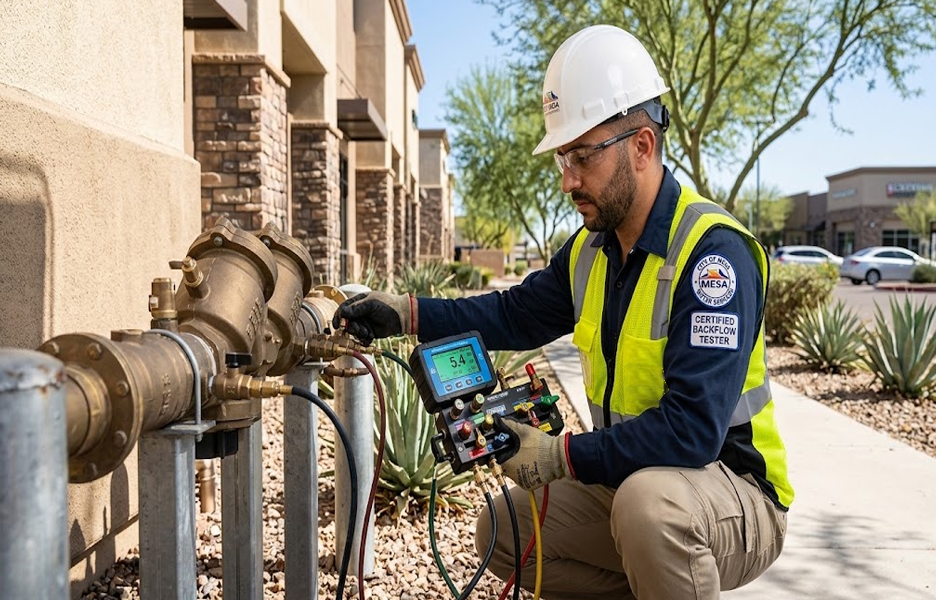
A backflow test is an exacting field calibration process, not a visual check. Certified technicians deploy a calibrated NIST-traceable 5-valve differential pressure test kit to measure internal spring tensions down to tenths of a Pound per Square Inch (PSI):
Static Pressure Verification: Technicians record incoming municipal dynamic and static line pressure.
Check Valve 1 Tightness Test: The technician pressurizes the first check valve, isolating it to verify it holds at least 5.0 PSID (Pounds per Square Inch Differential) against backpressure.
Relief Valve Opening Point (RPZ Specific): The differential pressure across the relief valve is gradually bled down. Technicians verify that the relief valve discharges to daylight before the differential drops below 2.0 PSID.
Check Valve 2 Directional Seal Test: High-pressure water is introduced downstream to confirm that the second check valve seals hermetically against backpressure without passing a single drop of fluid backward.
Air Inlet Valve Opening (PVB Specific): On landscape vacuum breakers, technicians verify that the air inlet canopy pops open when line pressure drops to 1.0 PSI, breaking any potential siphon.
If testing reveals cracked internal springs, torn diaphragms, or calcium scaling from Arizona hard water, the technician replaces the internal rubber kit, re-cleans the brass seats, and performs an immediate verification re-test.
5. Strategic Considerations for Multi-Unit & Commercial Portfolios
For asset managers overseeing commercial strip malls, business parks, and multi-family portfolios in the East Valley, managing backflow compliance requires a centralized calendar:
Preventing Water Service Termination: Municipalities issue a 10-day Notice of Violation if an annual test is missed, followed by a final 48-Hour Shut-Off Notice. If water is disconnected for non-compliance, restoring service requires paying disconnection and reconnection fees, testing penalties, and emergency testing charges.
Winter Cold Snap Vulnerability: While Arizona is famed for blistering summers, winter freezes routinely crack exposed commercial backflow canopies. Uninsulated bronze assemblies freeze, rupture internal poppets, and flood commercial properties. Applying certified R-8 marine-grade insulation pouches preserves assembly integrity.
Multi-Family Repiping Integration: When executing building-wide piping upgrades on older apartment communities, backflow prevention assemblies must be recertified following line modernizations.
To explore strategic CapEx planning and whole-building piping modernizations, review our multi-unit repiping strategic guide for property managers:
https://apsplumbingaz.com/multi-unit-repiping-mesa-property-managers-guide/
For comprehensive whole-building line replacements, consult our certified home repiping services in Arizona:
https://apsplumbingaz.com/home-repiping-arizona/
6. Emergency Failures and Secondary Structural Risks
When a large commercial backflow assembly fails catastrophically or discharges continuously:
Sewer & Storm Drain Overloads: A commercial 4-inch RPZ valve running at full discharge can dump several hundred gallons per minute onto parking lots or landscape beds. If cleanouts or exterior drains are compromised, this volume rapidly backs up. Learn how heavy runoff affects private drainage in our analysis on sewer line backups during Arizona monsoon storms:
https://apsplumbingaz.com/sewer-line-backup-arizona-monsoon-storms/
Emergency Water Containment: If a commercial backflow body splits due to mechanical impact or thermal stress, immediately isolate the unit using the upstream shut-off handle and contact our 24/7 commercial emergency response team for emergency pipe repairs in Arizona:
Renovation & Tenant Improvements: If you are configuring new tenant spaces, dental offices, or restaurant kitchens requiring dedicated grease traps and secondary backflow units, review local codes at renovation plumbing in Arizona:
Frequently Asked Questions: Mesa & Chandler Commercial Backflow
Q: Who is legally responsible for scheduling backflow testing on leased commercial buildings?
A: Under both Mesa and Chandler municipal codes, legal compliance ultimately falls on the recorded property owner. While triple-net (NNN) commercial lease contracts often delegate maintenance costs to the commercial tenant, the city issues violation notices, fines, and water shut-off orders directly to the property parcel owner.
Q: Can any licensed plumber perform commercial backflow testing in Arizona?
A: No. Standard plumbing licensing is insufficient. The technician must hold an active certification as a Backflow Prevention Assembly Tester certified by an approved agency (such as ABPA, ASSE, or AZ-CCCA) and their differential test gauges must be recalibrated annually to NIST standards.
Q: Why is water constantly dumping out of my RPZ backflow preventer?
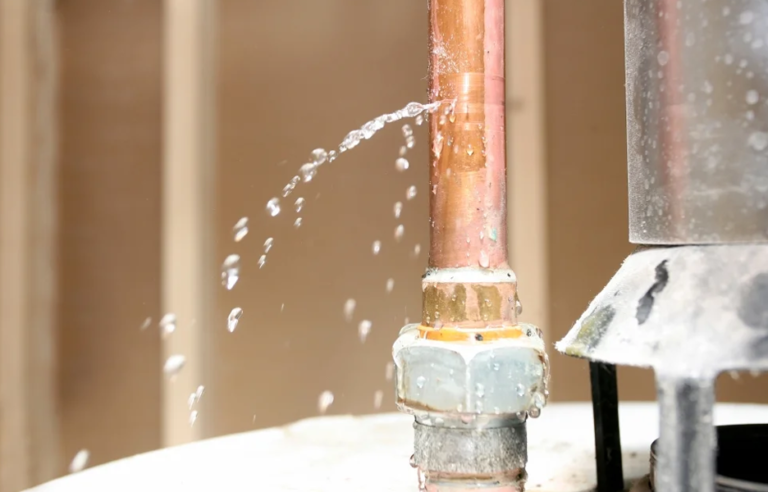
A: Continuous discharge from an RPZ’s central relief port indicates mechanical failure. Either debris (sand, pipe scale, or mineral buildup) is wedged inside the first check valve seat, preventing it from sealing, or the internal rubber diaphragm has torn, triggering an automatic safety discharge to prevent cross-contamination.
Q: How long does a standard commercial backflow test take?
A: An unobstructed commercial backflow test typically takes between 20 to 45 minutes per assembly. Water service to downstream fixtures is temporarily isolated for 10 to 20 minutes during the differential pressure evaluation.
Schedule Commercial Backflow Testing with APS Plumbing
Keep your commercial property compliant, avoid municipal shut-off notices, and ensure public water safety. Contact the certified backflow and commercial plumbing specialists at Aqua Plumbing Services (APS Plumbing) for annual testing, electronic municipal reporting, internal rebuilds, and emergency replacements across Mesa, Chandler, Phoenix, Scottsdale, and Gilbert.
Schedule your commercial backflow certification test today: