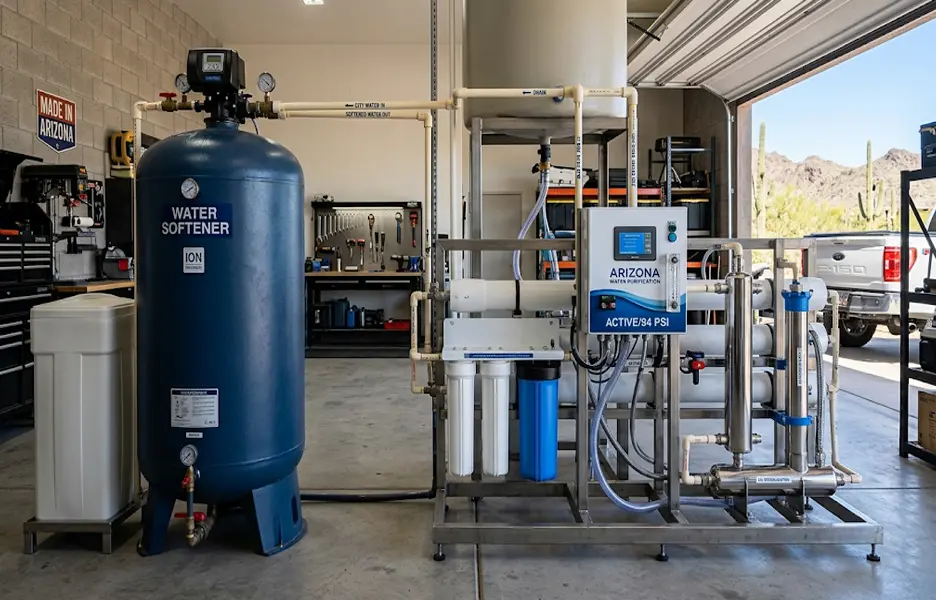
Quick answer: Multiply people × about 75 gallons per day × your water hardness (GPG) to get the grains to remove each day. A family of six at 20 GPG removes about 9,000 grains a day, so a 48,000–64,000 grain metered (demand-initiated) softener with a 1-inch valve is a good fit. It regenerates every few days instead of nightly and keeps pressure up when several showers run at once. Salt-free conditioners reduce scale but do not actually soften water.
Big households put a lot of water through a softener: back-to-back showers, daily laundry, the dishwasher, often guests on weekends. In the Phoenix area that water is also very hard. A softener that is too small runs out of capacity before it regenerates, and hard water slips through to your water heater and fixtures. This is called hardness breakthrough.
Here is how to size a softener correctly for a family of five or more in Phoenix, Scottsdale, Mesa, Chandler or Gilbert.
Step 1: Work out your daily grain removal
Use this formula:
People × 75 gallons/day × hardness (GPG) = grains removed per day
Example: a family of six in a 20 GPG area: 6 × 75 × 20 = 9,000 grains per day.
Your city’s water quality report lists hardness. Some reports show it in mg/L; divide by 17.1 to convert to GPG.
Step 2: Pick a capacity that regenerates every 3–7 days
Regenerating every few days is easier on the resin and uses less salt and water than regenerating every night. At 9,000 grains a day, four days between cycles needs at least 36,000 grains of usable capacity. Because a softener’s usable capacity at efficient salt settings is lower than its label rating, large Valley families are usually best served by a 48,000 to 64,000 grain unit.
| Household | Typical hardness | Suggested capacity | Valve size |
|---|---|---|---|
| 1–3 people | 15 GPG | about 32,000 grains | 3/4 inch |
| 4–5 people | 20 GPG | about 48,000 grains | 1 inch |
| 6–8 people | 20–25 GPG | about 64,000 grains | 1 inch |
| 8+ / multi-generational | 25+ GPG | Twin-tank (alternating) system | 1 inch or larger |
Step 3: Choose a 1-inch valve for larger homes
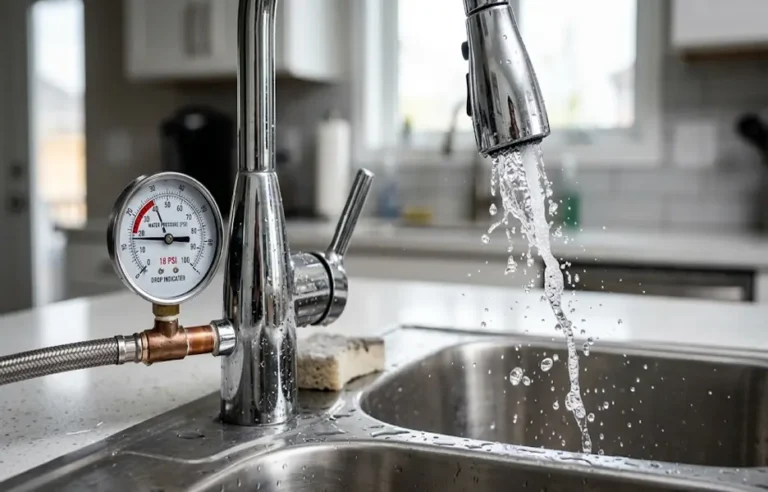
Many retail softeners use a 3/4-inch valve. In a large home with several bathrooms, that can restrict flow so pressure drops when two showers, the washer and a faucet run at once. A 1-inch valve and matching plumbing keep flow up. If pressure is low even with nothing else running, the cause is usually elsewhere; see why water pressure drops in the Arizona summer or signs of a failing PRV.
Step 4: Metered (demand-initiated) vs. timed regeneration
A timed softener regenerates on a fixed schedule whether you used a little water or a lot. Busy weeks can exhaust it early; quiet weeks waste salt. A metered or demand-initiated (DIR) softener measures actual water use and regenerates only when the resin needs it. For a large family it is the better choice.
Salt-based softener vs. salt-free conditioner
| Salt-based softener (ion exchange) | Salt-free conditioner (TAC/scale inhibitor) | |
|---|---|---|
| Removes calcium and magnesium | Yes | No, changes how they form scale |
| Spots on glass and shower doors | Largely eliminated | Reduced, not eliminated |
| Soap and detergent use | Noticeably lower | About the same |
| Best for | Large, high-use households | Smaller homes or where salt discharge is restricted |
Don’t forget filtration
A sediment pre-filter protects the softener, and an under-sink reverse osmosis system gives better-tasting drinking water. Softened water also makes RO filters last longer; see how to double your water filter life.
Professional sizing and installation
We test your water, size the unit, set the hardness and regeneration settings correctly and install a bypass so you can service it easily. Learn about water softener installation, typical water softener installation costs in Phoenix, and what hard water does to appliances.
Frequently Asked Questions
What size water softener does a family of 6 need in Phoenix?
At about 20 GPG, a family of six removes roughly 9,000 grains a day, so a 48,000 to 64,000 grain metered softener is usually the right size.
Is a 1-inch valve better than 3/4-inch on a water softener?
For larger homes with several bathrooms, a 1-inch valve allows more flow and helps prevent pressure drops when multiple fixtures run at the same time.
Are salt-free water conditioners good for Arizona?
They reduce scale on heating surfaces, but they do not remove hardness minerals, so you will still see spots and use more soap. Large families usually get better results from a salt-based softener.
How often should a water softener regenerate?
Ideally every three to seven days. A softener that regenerates every night is usually undersized or set incorrectly.
Need a plumber in Scottsdale or Phoenix?
APS Plumbing (Aqua Plumbing Services LLC) answers 24/7 across Scottsdale, Phoenix, Paradise Valley, Tempe, Mesa, Chandler, Gilbert and Glendale. 10% off for military personnel and 12 months no-interest financing available.