Quick answer: If a gas water heater gives no hot water, first check that the gas supply valve is open and other gas appliances work, then look at the pilot or ignition status light and follow the relighting instructions on the tank label. Lukewarm water usually points to sediment, a thermostat set too low or a failing gas valve or thermocouple. Call a plumber if you smell gas, see water leaking from the tank, the relief valve keeps discharging, or the pilot will not stay lit.
Waking up to a cold shower is one of the most common calls we get in Scottsdale and Phoenix. Many causes are simple, but some involve gas and need a professional. Start with the safe checks below.
Safety first
If you smell gas, do not try to relight anything. Leave the house and call your gas utility and 911 from outside; see what to do about a gas leak.
Symptom guide
| Symptom | Likely cause | What to do |
|---|---|---|
| No hot water at all | Pilot out, gas off, ignition or gas valve fault | Check gas valve, relight per label; call if it won’t stay lit |
| Lukewarm water / runs out fast | Sediment, thermostat low, failing burner or dip tube | Raise setting slightly, flush tank; call if no change |
| Popping or rumbling | Sediment on the tank bottom (very common in hard water) | Flush the tank |
| Rusty or smelly hot water | Worn anode rod or tank corrosion | Anode check or replacement |
| Water around the base | Leaking fitting, relief valve or failing tank | Turn off gas and cold supply; call a plumber |
| Relief valve dripping or discharging | High pressure or temperature, faulty valve, missing expansion tank | Call a plumber; do not cap the valve |
Simple checks you can do
- Gas supply: make sure the gas shut-off on the line to the heater is open and the stove works.
- Pilot or status light: many newer heaters have a sealed burner with a status light that flashes an error code; check the label or manual.
- Thermostat: confirm the control is not on “Vacation” or set too low.
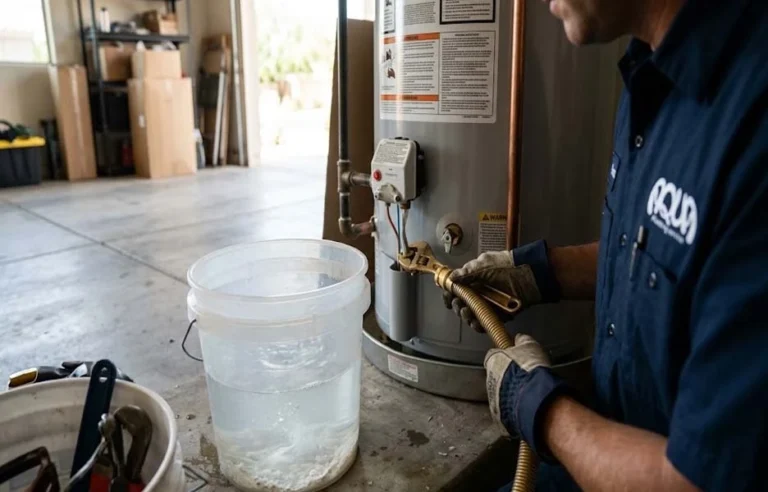
- Flush the tank: sediment builds fast in Valley water. How to drain and flush a gas water heater.
Repair or replace?
- Repair usually makes sense for a thermocouple, flame sensor, igniter, gas valve, anode rod or relief valve on a younger heater.
- Replace when the tank itself leaks, or the heater is older and needs a major part. Scottsdale’s water heater handout notes an average water heater lifespan of about 12 years, and that replacing anodes every 3–4 years (more often with softened water) adds considerable life.
Replacing a water heater requires a permit in Scottsdale; see Scottsdale permit rules. Thinking of switching? Read best tankless heaters for Arizona hard water. Electric heater? See electric element failure symptoms.
APS Plumbing provides same-day water heater repair in Scottsdale and water heater replacement across the Valley.
Frequently Asked Questions
Why is my gas water heater not producing hot water?
Common causes are a pilot or ignition failure, a closed gas valve, a faulty thermocouple or gas control valve, or heavy sediment. Check the gas supply and status light first.
Why does my water heater make popping noises?
Sediment from hard water collects on the tank bottom and makes popping or rumbling sounds as water under it boils. Flushing the tank helps.
How long does a water heater last in Arizona?
Scottsdale’s water heater guidance cites an average of about 12 years, and hard water can shorten that without maintenance such as flushing and anode replacement.
Should I repair or replace my water heater?
Repair parts like igniters, thermocouples or valves on younger units. Replace the heater if the tank leaks or it is near the end of its life.
Need a plumber in Scottsdale or Phoenix?
APS Plumbing (Aqua Plumbing Services LLC) answers 24/7 across Scottsdale, Phoenix, Paradise Valley, Tempe, Mesa, Chandler, Gilbert and Glendale. 10% off for military personnel and 12 months no-interest financing available.