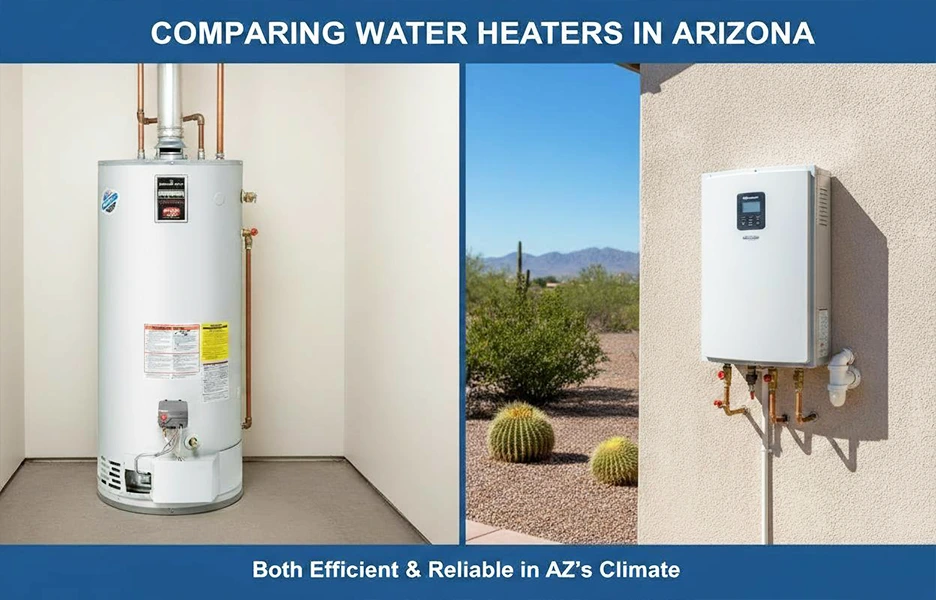
Choosing between a conventional storage tank water heater and a high-efficiency tankless water heater is one of the most impactful mechanical investments an Arizona property owner can make. In regions like Phoenix, Scottsdale, Mesa, Chandler, and Gilbert, water heating performance is not just about fuel source—it is dictated by extreme desert climate dynamics and severe groundwater hardness averaging 15 to 25+ Grains per Gallon (GPG).
Operating a water heater in Central Arizona presents physical challenges that national buying guides completely overlook: incoming summer groundwater temperatures that can exceed 85°F, rapid calcium carbonate precipitation inside heating chambers, and heavy sediment crusting that destroys storage tanks years ahead of schedule. Below is the comprehensive technical breakdown from the master plumbers at Aqua Plumbing Services to evaluate upfront equipment costs, monthly utility savings, installation infrastructure, and hard water maintenance requirements.
Quick Verdict: Which System Wins for Your Arizona Property?
- Select a High-Efficiency Tankless System if: You want endless, continuous hot water for back-to-back showers and high-demand appliances, aim to lower monthly water heating energy bills by 30% to 45%, want a durable 20+ year asset lifespan, and have or plan to install a whole-home water softening system to protect the internal heat exchangers.
- Select a Traditional Storage Tank if: You need a direct, lower initial capital replacement that fits existing 1/2-inch gas lines, atmospheric venting, or 240V electrical circuits without paying for gas meter upsizing, complex side-wall venting penetrations, or dedicated electrical rewiring.
Comprehensive Technical Comparison: Tankless vs. Storage Tank
Here is how modern condensing on-demand units compare head-to-head against standard atmospheric and power-vent storage tank water heaters under Arizona operating conditions:
| Performance Metric | Traditional Storage Tank | Condensing Tankless (On-Demand) |
|---|---|---|
| Average Arizona Lifespan | 6 – 10 Years (calcification failures common) | 20+ Years (with annual descaling maintenance) |
| Uniform Energy Factor (UEF) | 0.58 – 0.65 (continuous standby thermal loss) | 0.90 – 0.97 (ultra-efficient condensing transfer) |
| Hot Water Capacity & Delivery | Limited to reservoir size (40–50 Gallons) | Continuous / Endless Flow (5 to 11+ GPM) |
| Energy Consumption Profile | 24/7 reheat cycle to maintain reservoir temperature | Fires strictly on demand when a hot faucet opens |
| Physical Dimensions & Footprint | Large cylinder (12–16 sq. ft. of floor space) | Compact wall-hung unit (suitcase profile) |
| Vulnerability to Major Flooding | High risk of sudden 50-gallon bottom seam burst | Negligible (contains no pressurized water reservoir) |
| Gas Sizing Requirements | Standard 34,000 – 40,000 BTUs (1/2″ supply) | 160,000 – 199,000 BTUs (often requires 3/4″ supply) |
| Hard Water Maintenance Protocol | Annual sediment bottom drain & sacrificial anode swap | Annual chemical or vinegar descaling loop flush |
The Impact of Arizona Groundwater: Mineral Scale & Thermal Wear
Municipal water throughout Maricopa County is drawn from a mixture of the Salt River Project (SRP), Central Arizona Project (CAP), and deep alluvial wells. This water contains heavy concentrations of dissolved calcium carbonate, magnesium, and silica. In water heating systems, thermal acceleration causes these minerals to precipitate out of liquid solution and solidify onto internal surfaces:
How Minerals Destroy Traditional Storage Tanks
In a standard storage tank, heavy calcium sediment settles onto the concave bottom of the steel tank. Over 3 to 5 years, this mineral layer can accumulate 4 to 8 inches in depth. This calcified barrier acts as an insulator between the gas burner below and the water above:
- Thermal Overheating: The burner must burn much hotter and longer to penetrate the mineral crust, causing metal fatigue in the glass-lined steel tank bottom.
- Rumbling & Popping Sounds: Water trapped under the sediment layer flash-boils into steam bubbles that burst violently through the crust (often called “water heater kettle rumble”).
- Premature Tank Rupture: The combination of sediment weight, overheated steel, and sacrificial anode depletion causes tank seam ruptures, flooding garages and interior closets.
How Minerals Affect Condensing Tankless Units
Tankless water heaters do not store water, eliminating bottom sediment accumulation. However, flash-heating hard water across narrow stainless steel heat exchanger channels causes limescale to plate along the interior walls. Left untreated, this scale chokes water flow, lowers thermal efficiency, and triggers error codes (such as high-limit temperature sensor lockouts). This makes pairing a tankless unit with an upstream water treatment platform essential.
Installation & Retrofitting Considerations for Arizona Homes
Replacing an existing storage tank with a high-capacity tankless water heater involves four mechanical checks:
- Gas Line Sizing and BTU Volumetric Flow:
Standard 50-gallon atmospheric tanks consume approximately 38,000 to 40,000 BTUs. Whole-home condensing tankless units (such as Navien, Rinnai, or Noritz) require up to 199,000 BTUs to deliver high flow rates during winter months. Many older homes in Phoenix have existing 1/2-inch black iron supply lines that must be upsized to dedicated 3/4-inch or 1-inch lines. Learn more about professional piping upgrades in our certified guide to gas line installation and sizing in Arizona. - Direct Concentric Venting:
Traditional tanks utilize metal B-vent chimneys that rely on natural convection. High-efficiency condensing units extract so much heat from combustion gases that the exhaust is cool enough to vent through solid Schedule 40 PVC, CPVC, or polypropylene pipe routed directly through exterior side walls or existing roof flashings. - Condensate Drainage and Neutralization:
Condensing units produce slightly acidic moisture as a byproduct of combustion. Code-compliant installations require running a dedicated condensate drain line with an inline limestone neutralizer trap to protect residential drainage piping from acid corrosion. - 120V Electrical Supply:
Modern gas tankless systems use microprocessors, digital control panels, electronic ignition, and built-in ceramic freeze-protection heaters that require a dedicated 120V standard grounded electrical outlet near the installation location.
Protecting Your Water Heating Investment with Water Conditioning
Whether you install an advanced tankless system or replace an existing storage tank, mitigating mineral hardness is critical to maximizing equipment lifespan. Review our comprehensive guide on water softener installation and replacement in Arizona to discover how ion-exchange conditioning eliminates limescale accumulation.
To evaluate top-rated condensing models equipped with dual stainless-steel heat exchangers specifically engineered for high-TDS desert water, explore our technical breakdown of the best tankless water heaters for Arizona hard water.
If your home experiences low water volume, temperature fluctuations during multiple fixture use, or banging pipes, read our engineering diagnostic on why Arizona homes struggle with water pressure issues to inspect your main pressure reducing valve (PRV).
Furthermore, if you are planning a broader residential remodel that includes relocating your water heater or expanding your bathroom layouts, explore our licensed renovation and remodel plumbing services for turnkey project coordination.
Frequently Asked Questions: Arizona Water Heaters
Q: How long do tankless water heaters last in Arizona compared to storage tanks?
A: With annual descaling and a water softener, tankless water heaters routinely last 20+ years in Arizona. Traditional storage tanks typically fail within 6 to 10 years due to heavy calcium sediment buildup that overheats and cracks the steel bottom.
Q: Do I need a water softener with a tankless water heater in Phoenix?
A: Yes, it is strongly recommended. Phoenix municipal water carries 15 to 25+ GPG of hardness. Flash-heating hard water without a water softener causes rapid limescale buildup along heat exchangers, reducing heating efficiency and potentially voiding manufacturer warranties.
Q: Does switching to a tankless water heater require gas line upgrades?
A: In many homes, yes. Standard 50-gallon tanks draw 34,000 to 40,000 BTUs, while whole-home tankless units require up to 199,000 BTUs. Depending on the distance from your gas meter, an upgrade to a 3/4-inch or 1-inch dedicated line may be necessary to ensure safe, code-compliant operation.
Q: Will a tankless water heater save money on my monthly Arizona utility bills?
A: Yes. Because tankless water heaters eliminate 24/7 standby thermal losses, homeowners typically experience a 30% to 45% reduction in the energy required for domestic water heating compared to traditional storage tanks.
Upgrade Your Water Heating System Today
Whether you need an emergency replacement for a leaking storage tank or want to install an endless on-demand tankless system, trust Arizona’s licensed water heating professionals at Aqua Plumbing Services for precision BTU sizing and code-compliant installations across Phoenix, Scottsdale, Mesa, Chandler, and Gilbert.